Caffè della VerGOGNA – edizione del 2 Ottobre 2026
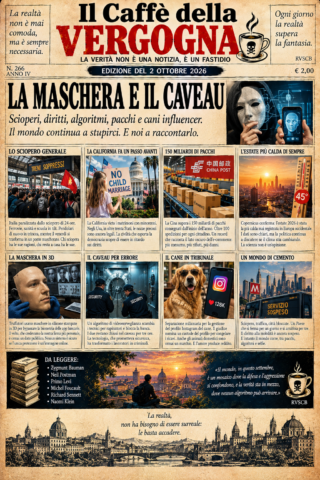
L’Italia si è svegliata paralizzata dallo sciopero generale di ventiquattro ore che ha bloccato insieme ferrovie, sanità e scuola pubblica, e sui social si è accesa la polemica sui servizi minimi garantiti e sul venerdì trasformato in ponte festivo camuffato. I pendolari, che ogni volta pagano il prezzo di una vertenza tra aziende e sindacati, hanno protestato contro una prassi che si ripete con la regolarità di un calendario liturgico, e le stazioni, prese d’assalto nelle poche fasce di garanzia, hanno offerto l’immagine consueta di un Paese che si ferma per un giorno e si arrabbia per tre. Chi sciopera ha le sue ragioni, e chi resta a casa ha le sue, ma il diritto alla mobilità, che la Costituzione promette, resta ogni volta sospeso in attesa che le parti trovino un accordo che nessuno ha ancora imparato a cercare in anticipo.
La California ha approvato una legge che vieta tassativamente i matrimoni con minori di diciotto anni, e la notizia ha scatenato un polverone etico perché l’opinione pubblica ha scoperto con sbigottimento che in oltre trenta Stati americani le nozze con minorenni, anche sotto i sedici anni con consenso genitoriale, sono ancora perfettamente legali. La civiltà che si vanta di esportare la democrazia nel mondo scopre di dover correggere una norma che in Europa sarebbe impensabile da decenni, e il ritardo, per quanto riguarda la prima potenza globale, la dice lunga sulla distanza che separa la retorica dei diritti dalla realtà delle leggi.
Il servizio postale cinese ha certificato il superamento di centocinquanta miliardi di pacchi consegnati dall’inizio dell’anno, oltre cento spedizioni per ogni singolo cittadino, e il dato, che sembra un record da celebrare, è in realtà il ritratto di una società dipendente dallo squasso ecologico dell’e-commerce e dalla gratificazione istantanea. Ogni pacco è un clic, ogni clic è un desiderio soddisfatto in poche ore, e il pianeta, che paga il conto in termini di imballaggi, trasporti e rifiuti, non ha voce in capitolo. Il consumo, quando diventa identità, produce statistiche che nessuno osa leggere fino in fondo.
Copernicus ha confermato che l’estate appena conclusa è stata la più calda mai registrata nell’Europa occidentale da quando esistono le misurazioni, e la notizia ha riacceso lo scontro tra negazionisti e catastrofisti. I dati sono chiari, le serie storiche sono inconfutabili, eppure la politica continua a discutere se il clima stia cambiando come se fosse una questione di opinione. Ottobre, che un tempo apparteneva alle foglie gialle e ai primi maglioni, si è trasformato in un prolungamento dell’estate, e la società che continua a parlarne come di un’imprevista eccezione ha smesso da tempo di prendere sul serio la scienza.
Una banda di truffatori è riuscita a bypassare i sistemi di autenticazione biometrica delle app bancarie stampando maschere iper-realistiche in silicone con stampanti 3D, costruite a partire da foto social in alta risoluzione delle vittime. La falla fa crollare l’illusione che la biometria sia un caveau inespugnabile, e dimostra che il volto, che credevamo la nostra firma più personale, è ormai un dato pubblico che chiunque può scaricare, stampare e indossare. La sicurezza informatica, che prometteva di proteggerci meglio delle password, è stata battuta da un artigiano digitale con una maschera di silicone, e la lezione è che nessun sistema è sicuro se l’unica cosa che lo protegge è un’immagine che pubblichiamo gratis su internet.
In una filiale bancaria automatizzata dell’Europa centrale, l’intelligenza artificiale installata per la videosorveglianza ha scambiato i movimenti bruschi di due tecnici di manutenzione per un tentativo di rapina, e il sistema ha fatto scattare il protocollo blindando le porte corazzate e lasciando i malcapitati al buio per tre ore prima che la centrale riuscisse a resettare il software. I due tecnici, che erano lì per riparare qualcosa, hanno scoperto che la macchina che doveva proteggere la banca li aveva trasformati in rapinatori per un algoritmo troppo zelante, e la vicenda, nella sua assurdità, è la fotografia di un mondo in cui le decisioni vengono prese da sistemi che nessuno ha imparato a controllare.
Infine, un tribunale civile è stato chiamato a dirimere una causa di separazione tra due ex coniugi benestanti che non litigano per immobili o azioni, ma per la gestione del profilo Instagram del loro cane, capace di generare decine di migliaia di euro in sponsorizzazioni. Il giudice ha nominato un custode giudiziario del profilo per congelare i ricavi in attesa della divisione dei beni, e la vicenda, che sembra una barzelletta, è invece la prova che anche gli animali domestici sono diventati marchi, e che l’amore per un cane, quando produce reddito, si trasforma in una questione patrimoniale che nessun codice aveva previsto. Il cane, ignaro di tutto, continua a scodinzolare mentre i suoi ex padroni si contendono i proventi delle sue fotografie.
Il caffè della vergogna, stamattina, sa di silicone e di binari fermi, di pacchi accatastati e di caveau chiusi per errore. L’Italia si ferma per uno sciopero, la California scopre di essere in ritardo sui diritti, la Cina batte ogni record di consumo, l’estate più calda di sempre diventa un dato archivistico, una maschera in 3D inganna le banche, un algoritmo rinchiude due tecnici nel caveau, e un cane influencer finisce in tribunale. La realtà, oggi, ha superato qualsiasi satira, e la domanda che resta aperta non riguarda il clima, la sicurezza o il lavoro: riguarda noi, e la nostra capacità di riconoscere, dietro ogni notizia, il volto che abbiamo costruito senza accorgercene.
Zygmunt Bauman, Consumo, dunque sono, Laterza, Roma-Bari, 2008
Neil Postman, Divertirsi da morire, Marsilio, Venezia, 2002
Primo Levi, Storie naturali, Einaudi, Torino, 1966
Michel Foucault, Sorvegliare e punire, Einaudi, Torino, 1976
Richard Sennett, L’uomo flessibile, Feltrinelli, Milano, 1999
Naomi Klein, Shock economy, Rizzoli, Milano, 2007
The Mask and the Vault Caffè della VerGOGNA — October 2, 2026 Edition
Italy woke up paralyzed by a twenty-four-hour general strike that blocked railways, healthcare, and public schools simultaneously, and on social media the controversy ignited over guaranteed minimum services and Friday transformed into a disguised holiday bridge. Commuters, who every time pay the price of a dispute between companies and unions, protested against a practice that repeats with the regularity of a liturgical calendar, and stations, stormed in the few guarantee slots, offered the customary image of a country that stops for one day and gets angry for three. Those striking have their reasons, and those staying home have theirs, but the right to mobility, which the Constitution promises, remains suspended each time waiting for parties to find an agreement no one has yet learned to seek in advance.
California passed a law strictly banning marriages with minors under eighteen, and the news triggered an ethical uproar because the public discovered with shock that in over thirty American states marriages with minors, even under sixteen with parental consent, are still perfectly legal. The civilization that boasts exporting democracy worldwide discovers it must correct a norm that in Europe would be unthinkable for decades, and the delay, concerning the first global power, speaks volumes about the distance separating rights rhetoric from legal reality.
Chinese postal service certified surpassing one hundred fifty billion packages delivered since the beginning of the year, over one hundred shipments per single citizen, and the figure, which seems a record to celebrate, is actually a portrait of a society dependent on the ecological waste of e-commerce and instant gratification. Every package is a click, every click is a desire satisfied in a few hours, and the planet, which pays the bill in terms of packaging, transport, and waste, has no voice in the matter. Consumption, when it becomes identity, produces statistics no one dares read to the end.
Copernicus confirmed that the summer just concluded was the hottest ever recorded in Western Europe since measurements exist, and the news reignited the clash between deniers and alarmists. The data are clear, historical series are irrefutable, yet politics continues discussing whether climate is changing as if it were a matter of opinion. October, which once belonged to yellow leaves and first sweaters, has transformed into an extension of summer, and society that continues to speak of it as an unforeseen exception has long stopped taking science seriously.
A band of scammers managed to bypass biometric authentication systems of banking apps by printing hyper-realistic masks in silicone with 3D printers, constructed starting from high-resolution social photos of victims. The flaw collapses the illusion that biometrics is an impregnable vault, and demonstrates that the face, which we believed our most personal signature, is now public data anyone can download, print, and wear. Cybersecurity, which promised to protect us better than passwords, was beaten by a digital artisan with a silicone mask, and the lesson is that no system is secure if the only thing protecting it is an image we publish freely on the internet.
In an automated bank branch in Central Europe, artificial intelligence installed for video surveillance mistook abrupt movements of two maintenance technicians for a robbery attempt, and the system triggered the protocol by sealing armored doors and leaving the unfortunate ones in darkness for three hours before the control center managed to reset the software. The two technicians, who were there to repair something, discovered that the machine that should protect the bank had turned them into robbers for an overly zealous algorithm, and the affair, in its absurdity, is a portrait of a world where decisions are made by systems no one has learned to control.
Finally, a civil court was called to resolve a separation lawsuit between two wealthy ex-spouses arguing not over property or stocks, but over management of their dog’s Instagram profile, capable of generating tens of thousands of euros in sponsorships. The judge appointed a judicial custodian of the profile to freeze revenues pending asset division, and the affair, which seems like a joke, is instead proof that even pets have become brands, and that love for a dog, when producing income, transforms into an estate matter no code had anticipated. The dog, unaware of everything, continues wagging his tail while his former owners fight over proceeds from his photographs.
This morning’s coffee of shame tastes of silicone and frozen tracks, piled-up packages and vaults closed by mistake. Italy stops for a strike, California discovers it is behind on rights, China beats every consumption record, the hottest summer ever becomes archive data, a 3D mask fools banks, an algorithm locks two technicians in the vault, and an influencer dog ends up in court. Reality, today, has surpassed any satire, and the question remaining open doesn’t concern climate, security, or work: it concerns us, and our capacity to recognize, behind every news item, the face we built without noticing.
Zygmunt Bauman, Consuming Life, Laterza, Rome-Bari, 2008 Neil Postman, Amusing Ourselves to Death, Marsilio, Venice, 2002 Primo Levi, Natural Histories, Einaudi, Turin, 1966 Michel Foucault, Discipline and Punish, Einaudi, Turin, 1976 Richard Sennett, The Corrosion of Character, Feltrinelli, Milan, 1999 Naomi Klein, The Shock Doctrine, Rizzoli, Milan, 2007


