Caffè della VerGOGNA – edizione del 23 Settembre 2026
Donald Trump ha aperto il suo intervento all’Assemblea Generale dell’Onu con una frase che vale un trattato di filosofia politica: altri hanno parlato di pace, io l’ho realizzata. Poi è tornato a Washington, dove la guerra con i media ha raggiunto un livello che nessuna democrazia aveva ancora sperimentato. Dopo il bando di alcune testate storiche dalla Casa Bianca, i principali network televisivi hanno sospeso la copertura in diretta del presidente, e lui ha inaugurato la nuova elipista quasi senza che nessuno lo riprendesse. La ritorsione è arrivata su Truth Social, sotto forma di meme generati dall’intelligenza artificiale in cui il tycoon veste i panni dei supereroi DC. La politica americana, ormai, si consuma tra un discorso al Palazzo di Vetro e una vignetta digitale, e il confine tra la comunicazione istituzionale e il cabaret si è dissolto come neve al sole.
In Campania, Vincenzo De Luca ha definito i colleghi d’opposizione salici piangenti e luciferini, e i Verdi hanno chiesto l’intervento ufficiale del Partito Democratico per contenere quello che hanno chiamato cabaret. Il governatore, che da anni ha fatto della battuta una seconda attività professionale, ha offerto alla stampa un nuovo campionario di perle di diplomazia, e la politica campana, che già di suo non conosce sobrietà, si avvia verso le elezioni con il consueto corredo di veleni e sarcasmi. Il problema, in questi casi, è che la battuta più felice resta sempre quella che offende qualcuno, e il riso dura il tempo di un titolo.
Antonio Tajani, dal canto suo, ha spiegato il concetto di scelta elettorale paragonando il voto alla scelta della propria moglie: quella carina ma con la gonna lunga. L’aula e i social sono esplosi, e il ministro degli Esteri si è ritrovato al centro di una bufera che nessun comunicato ha potuto spegnere. La metafora, oltre a essere infelice, racconta un modo di intendere le relazioni e le decisioni pubbliche che appartiene a un’altra epoca, e il fatto che venga pronunciata da chi rappresenta l’Italia nel mondo rende la questione più seria di quanto i commenti ironici lascino intendere.
In Massachusetts, la polizia ha arrestato Braden Eric Peters, vent’anni, noto sul web come Clavicular, uno dei volti simbolo del trend looksmaxxing, l’ossessione per il miglioramento estetico estremo attraverso esercizi facciali e posture. L’influencer dovrà rispondere di pesanti accuse di violenza e somministrazione di sostanze, e i media americani stanno smantellando l’ennesimo mito patinato costruito sui social. Il culto dell’apparenza, quando si trasforma in professione, produce mostri che nessun filtro può nascondere, e la vicenda di Clavicular è la dimostrazione che dietro ogni volto perfetto può nascondersi una biografia che nessuno vorrebbe leggere.
A Pordenone, un intero quartiere è sotto il terrore di una cornacchia aggressiva che da mesi becca sistematicamente i passanti in testa. La vicenda è arrivata sugli scranni del consiglio comunale, al punto da far valutare un’ordinanza straordinaria per neutralizzare il volatile stalker. Un uccello è riuscito dove la politica locale fallisce da anni: mettere d’accordo tutti sulla necessità di un intervento, e la cornacchia, con il suo becco puntuto, è diventata il problema pubblico più urgente della città. La fauna urbana, quando decide di dichiararci guerra, trova sempre il modo di ricordarci che il territorio non è soltanto nostro.
All’aeroporto di Torino-Caselle, i controlli di sicurezza hanno vissuto momenti di sconcerto quando gli addetti ai raggi X hanno notato una sagoma inusuale nel bagaglio di un passeggero. Non si trattava di armi né di sostanze illecite, ma di un’intera testa di coccodrillo imbalsamata, trasportata come souvenir non dichiarato. Il viaggiatore è stato denunciato e la testa sequestrata, e il coccodrillo, che aveva attraversato il mondo per finire in una valigia, ha concluso la sua esistenza in un deposito doganale. I souvenir, a volte, sono il modo più assurdo di portare a casa un pezzo di altrove.
Sui social turchi è diventata virale la partita Cagliari-Lecce, e il motivo ha del surreale: migliaia di tifosi e streamer si sono organizzati in chat di gruppo per guardare il match con l’obiettivo dichiarato di annoiarsi e commentare la lentezza del gioco tattico italiano. Un nuovo livello di intrattenimento ironico-masochista, che trasforma la noia in spettacolo e il campionato italiano in un fenomeno di culto per chi cerca il vuoto con metodo scientifico. Il calcio nostrano, che da decenni si interroga sulla propria crisi, scopre di essere divertente proprio quando non diverte.
Infine, i procuratori di Parigi hanno aperto un’indagine formale dopo una raffica di denunce sull’uso improprio dei nuovi occhiali smart con fotocamera integrata, sviluppati da Meta ed EssilorLuxottica. Centinaia di persone si sono accorte di essere state riprese di nascosto per strada da passanti che indossavano semplici occhiali da vista, e il confine tra innovazione tecnologica e voyeurismo quotidiano è ufficialmente crollato. La tecnologia che prometteva di aumentare la realtà ha finito per violare la privacy di chi cammina senza sospettare che qualcuno lo stia guardando attraverso una montatura di design.
Il caffè della vergogna, stamattina, sa di supereroi digitali e di piume nere, di coccodrilli imbalsamati e di occhiali spia. Un presidente parla di pace e si vendica con i meme, un governatore insulta i colleghi a colpi di aggettivi, un ministro paragona il voto alla gonna della moglie, un influencer finisce in manette, una cornacchia semina il panico a Pordenone, una testa di rettile viaggia in valigia, i turchi si annoiano guardando il campionato italiano, e a Parigi qualcuno denuncia di essere stato filmato da un paio di occhiali. La realtà, oggi, ha superato anche la rassegna di ieri, e il bello è che nessuno di questi fatti è inventato.
Umberto Eco, Diario minimo, Bompiani, Milano, 1963
Neil Postman, Divertirsi da morire, Marsilio, Venezia, 2002
Guy Debord, La società dello spettacolo, Baldini Castoldi Dalai, Milano, 2002
Italo Calvino, Le cosmicomiche, Einaudi, Torino, 1965
Philip K. Dick, Ma gli androidi sognano pecore elettriche?, Mondadori, Milano, 1968
Zygmunt Bauman, Consumo, dunque sono, Laterza, Roma-Bari, 2008
Konrad Lorenz, L’anello di re Salomone, Adelphi, Milano, 1967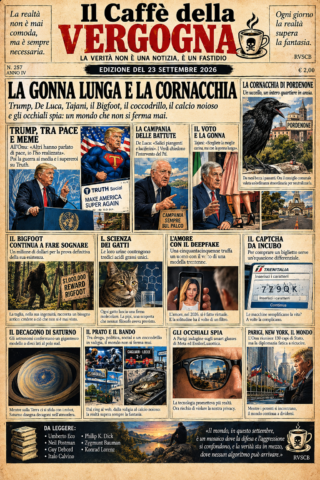
The Long Skirt and the Crow Caffè della VerGOGNA, September 23, 2026 edition
Donald Trump opened his address to the UN General Assembly with a phrase worth a treatise on political philosophy: others have spoken of peace, I have achieved it. Then he returned to Washington, where the war with the media reached a level no democracy had yet experienced. After banning historic news outlets from the White House, the major television networks suspended live coverage of the president, and he inaugurated the new heliport almost without anyone filming him. The retaliation arrived on Truth Social, in the form of memes generated by artificial intelligence depicting the tycoon dressed as DC superheroes. American politics, by now, unfolds between a speech at the Glass Palace and a digital cartoon, and the boundary between institutional communication and cabaret has melted like snow in the sun.
In Campania, Vincenzo De Luca described his opposition colleagues as weeping willows and Luciferians, and the Greens called for the Democratic Party’s official intervention to contain what they dubbed a cabaret. The governor, who for years has made wisecracking a second profession, offered the press a fresh catalogue of diplomatic gems, and Campanian politics, never sober to begin with, heads toward the elections with its customary baggage of venom and sarcasm. The problem, in such cases, is that the happiest joke is always the one that offends someone, and laughter lasts the length of a headline.
Antonio Tajani, for his part, explained the concept of electoral choice by comparing voting to choosing one’s wife: the pretty one, but wearing a long skirt. The chamber and social media erupted, and the Foreign Minister found himself at the center of a storm no press release could extinguish. The metaphor, besides being unfortunate, describes a way of understanding relationships and public decisions that belongs to another era, and the fact that it was uttered by the man who represents Italy to the world makes the matter more serious than the ironic comments suggest.
In Massachusetts, police arrested Braden Eric Peters, twenty years old, known online as Clavicular, one of the emblematic faces of the looksmaxxing trend — the obsession with extreme aesthetic improvement through facial exercises and postures. The influencer will face serious charges of violence and administering substances, and the American media are dismantling yet another glossy myth built on social media. The cult of appearances, when it becomes a profession, produces monsters no filter can hide, and Clavicular’s story is proof that behind every perfect face can lie a biography no one would want to read.
In Pordenone, an entire neighborhood lives in terror of an aggressive crow that for months has been systematically pecking passersby on the head. The affair has reached the seats of the city council, to the point of prompting consideration of an extraordinary ordinance to neutralize the stalker bird. A single bird has achieved what local politics has failed to do for years: getting everyone to agree on the need for intervention, and the crow, with its pointed beak, has become the city’s most urgent public problem. Urban wildlife, when it decides to declare war on us, always finds a way to remind us that the territory is not ours alone.
At Turin-Caselle airport, security screening saw moments of bewilderment when X-ray operators noticed an unusual shape in a passenger’s luggage. It was neither weapons nor illicit substances, but an entire stuffed crocodile head, transported as an undeclared souvenir. The traveler was reported and the head seized, and the crocodile, having crossed the world only to end up in a suitcase, concluded its existence in a customs warehouse. Souvenirs, at times, are the most absurd way of bringing home a piece of elsewhere.
On Turkish social media, the Cagliari-Lecce match went viral, and the reason was surreal: thousands of fans and streamers organized in group chats to watch the game with the declared goal of being bored and commenting on the slowness of Italian tactical play. A new level of ironic-masochistic entertainment, transforming boredom into spectacle and the Italian league into a cult phenomenon for those who pursue emptiness with scientific method. Our national football, which for decades has pondered its own crisis, discovers it is entertaining precisely when it does not entertain.
Finally, Paris prosecutors have opened a formal investigation following a wave of complaints over the improper use of the new smart glasses with built-in cameras, developed by Meta and EssilorLuxottica. Hundreds of people discovered they had been secretly filmed on the street by passersby wearing ordinary prescription glasses, and the boundary between technological innovation and everyday voyeurism has officially collapsed. The technology that promised to augment reality has ended up violating the privacy of those who walk unaware that someone is watching them through designer frames.
The coffee of shame, this morning, tastes of digital superheroes and black feathers, of stuffed crocodiles and spy glasses. A president speaks of peace and takes revenge with memes, a governor insults colleagues with adjectives, a minister compares voting to his wife’s skirt, an influencer ends up in handcuffs, a crow sows panic in Pordenone, a reptile head travels in a suitcase, the Turks bore themselves watching the Italian league, and in Paris someone reports being filmed by a pair of glasses. Reality today has surpassed even yesterday’s roundup, and the best part is that none of these facts is invented.
Umberto Eco, Misreadings, Bompiani, Milan, 1963 Neil Postman, Amusing Ourselves to Death, Marsilio, Venice, 2002 Guy Debord, The Society of the Spectacle, Baldini Castoldi Dalai, Milan, 2002 Italo Calvino, Cosmicomics, Einaudi, Turin, 1965 Philip K. Dick, Do Androids Dream of Electric Sheep?, Mondadori, Milan, 1968 Zygmunt Bauman, Consuming Life, Laterza, Rome-Bari, 2008 Konrad Lorenz, King Solomon’s Ring, Adelphi, Milan, 1967


