Caffè della VerGOGNA – edizione del 21 Settembre 2026
Il colpo di pistola è partito nella notte, tra le due e le due e mezza, quando il proprietario della cascina in ristrutturazione ha sentito dei rumori provenire dal cortile e vi ha sorpreso quattro o cinque persone. L’uomo, un autotrasportatore di trentacinque anni, ha esploso un colpo con la semiautomatica regolarmente detenuta, e il proiettile ha raggiunto Gjovalin Lazri, albanese di trentacinque anni residente a Torino con precedenti per reati contro il patrimonio. I soccorsi sono arrivati, ma per il ladro non c’è stato nulla da fare. Il proprietario è indagato per omicidio, i carabinieri di Bra e Cuneo indagano sotto il coordinamento della Procura di Asti, e nelle prossime ore verranno disposti l’autopsia e l’esame balistico. Matteo Salvini, dal palco di Pontida, ha detto che il suo abbraccio va a chi è stato aggredito e si è difeso a casa sua. La legittima difesa, in Italia, resta un terreno dove il confine tra la paura e la violenza si sposta a seconda di chi racconta i fatti.
Romano Prodi, in un’intervista al Sole 24 Ore, ha detto che se l’AfD vince le elezioni tedesche l’Europa è finita. Il partito di estrema destra è antieuropeo, nazionalista, razzista, e la Germania, che dopo la guerra in Ucraina ha avviato un programma di riarmo destinato a farne la più grande potenza militare del continente, trascinerebbe con sé l’intera costruzione europea. Prodi ha criticato la Commissione, che fa proposte e poi si ferma, e ha citato il Ceta, l’accordo con il Canada firmato nel 2016 e ancora non ratificato da dieci Paesi, Italia compresa. I bei discorsi, ha aggiunto, si fermano davanti ai metodi di voto che impediscono di attuare le decisioni. L’Europa, in questa lettura, è un gigante che parla e non cammina.
Le elezioni in Germania hanno confermato i timori. In Meclemburgo-Pomerania Anteriore l’AfD ha conquistato il trentasette virgola sette per cento, la Spd il trentacinque virgola cinque, e la Cdu è crollata sotto la soglia di sbarramento, per la prima volta nel Dopoguerra esclusa da un parlamento regionale. Friedrich Merz ha parlato di disastro, ha escluso le dimissioni e ha promesso riforme, spina dorsale e pazienza. Alice Weidel ha invitato i cristiano-democratici ad abbandonare il cordone sanitario contro l’estrema destra, e a Berlino Die Linke ha vinto con oltre il venticinque per cento, mentre l’AfD si è fermata al terzo posto. La Germania che per settant’anni ha espiato i propri fantasmi si ritrova a guardare in faccia un elettorato che ha smesso di credere nelle rassicurazioni dei partiti tradizionali.
A San Diego, un labrador di nome Nash ha accolto un ladro con entusiasmo, gli ha portato i giochi, ha assistito scondinzolando alle sue scorribande in cucina e al pisolino sul divano, e ha fatto le feste anche ai poliziotti arrivati per arrestarlo. Le telecamere di sorveglianza hanno documentato la scena, e il video è diventato virale. Il cane da guardia che diserta il proprio dovere con tanta allegria è l’immagine più tenera e più inutile della settimana, e forse anche una metafora di un Paese che si affida a protezioni che non proteggono.
Giorgia Meloni, dal palco di Gioventù Nazionale all’Eur, ha annunciato che sta per arrivare in Consiglio dei ministri un provvedimento che introduce per legge il numero massimo di studenti stranieri per classe, l’obbligo per i genitori di imparare l’italiano e il divieto di burqa e niqab a scuola. Ha poi pungentato le opposizioni sul bollo auto, ha proposto un conto corrente dedicato ai nostalgici che vogliono pagarlo, ha attaccato Elly Schlein invitandola a trovare un argomento vero, e ha messo in guardia dagli algoritmi che nelle ultime settimane prima del voto cercheranno di manipolare la democrazia. Roberto Vannacci, da Orvieto, ha replicato che le alleanze si fanno a ridosso delle elezioni, e la premier, senza nominarlo, ha lanciato il suo guanto di sfida sull’immigrazione e sulla scuola. La campagna elettorale, in questo settembre, è già cominciata, e i toni si sono alzati.
Giuseppe Conte, dal World Join Center di Milano, ha gridato «tocca a noi» una dozzina di volte, ha strappato con le mani i fogli delle tre firme che secondo lui Meloni ha apposto a danno dell’interesse nazionale, dal patto di stabilità al riarmo fino all’aumento delle spese Nato al cinque per cento, e ha promesso una tabula rasa. Elly Schlein ha replicato che le cose in comune sono quattromilacinquecento e che nessuno intende fare il favore alla destra di dividerli come nel 2022. Il campo largo, in questa versione, è un cantiere aperto dove le ruspe lavorano in direzioni diverse.
A New York, quasi centotrenta capi di Stato e di governo si riuniranno per la settimana di alto livello dell’Assemblea generale delle Nazioni Unite, dedicata a ripristinare la fiducia e gestire la trasformazione. Donald Trump arriverà lunedì, parlerà martedì, incontrerà il premier britannico, la premier giapponese e i leader del Golfo, ma non vedrà Netanyahu e forse nemmeno Zelensky. Giorgia Meloni non parteciperà, e l’Italia sarà rappresentata da Antonio Tajani. Friedrich Merz ha cancellato il viaggio per ragioni di politica interna. Il Palazzo di Vetro, ancora una volta, sarà il teatro di una diplomazia che cerca di ricucire ciò che il mondo strappa ogni giorno.
Mauro Corona, a Verissimo, si è definito possessivo, geloso, violento a livello verbale e traditore. Ha raccontato del fratello morto annegato in una piscina a diciassette anni, del padre che legava i figli al palo per sei o sette ore, della coltellata che gli ha ferito le dita, e ha detto che non cerca il perdono degli altri ma il perdono di se stesso. Lo scrittore e scultore, a settantasei anni, ha tracciato un bilancio senza sconti, e le sue parole, nella loro crudezza, suonano come una confessione che nessuna assoluzione potrà mai cancellare.
Il caffè della vergogna, stamattina, sa di polvere da sparo e di prato, di urne e di alberi genealogici. Un uomo spara a un ladro e finisce indagato, la Germania consegna un Land all’estrema destra, un labrador fa festa agli intrusi, Meloni annuncia la stretta sugli stranieri, Conte promette la tabula rasa, l’Onu cerca la fiducia, e Mauro Corona confessa le violenze di una vita. Il mondo, in questo settembre, è un mosaico dove la difesa e l’aggressione si confondono, e la verità sta in mezzo, dove nessun algoritmo può arrivare.
Leonardo Sciascia, Il giorno della civetta, Einaudi, Torino, 1961
Hannah Arendt, Sulla violenza, Guanda, Parma, 1996
Zygmunt Bauman, Paura liquida, Laterza, Roma-Bari, 2006
Primo Levi, I sommersi e i salvati, Einaudi, Torino, 1986
Elias Canetti, Massa e potere, Adelphi, Milano, 1981
Susan Sontag, Davanti al dolore degli altri, Mondadori, Milano, 2003
Michel Foucault, Sorvegliare e punire, Einaudi, Torino, 1976
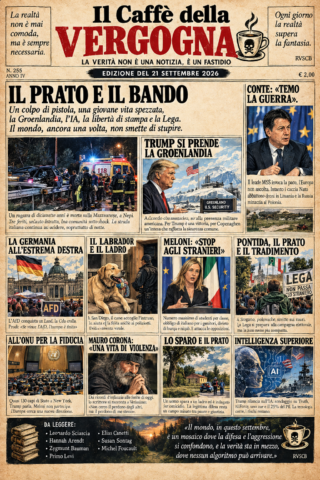
The Shot and the Lawn Caffè della VerGOGNA, September 21, 2026 edition
A pistol shot rang out during the night, between two and two thirty, when the owner of the farmhouse under renovation heard noises coming from the courtyard and surprised four or five people. The man, a thirty-five-year-old truck driver, fired a shot with his semi-automatic firearm held lawfully, and the bullet struck Gjovalin Lazri, a thirty-five-year-old Albanian resident of Turin with prior convictions for property crimes. Rescue personnel arrived, but there was nothing to be done for the burglar. The owner is under investigation for homicide; the Carabinieri units of Bra and Cuneo are investigating under the coordination of the Asti Prosecutor’s Office, and in the coming hours autopsy and ballistics examination will be ordered. Matteo Salvini, from the stage in Pontida, said his embrace goes to whoever was attacked and defended himself in his own home. Legitimate defense in Italy remains terrain where the boundary between fear and violence shifts depending on who narrates the facts.
Romano Prodi, in an interview with Il Sole 24 Ore, said that if the AfD wins the German elections, Europe is finished. The far-right party is anti-European, nationalist, racist, and Germany, which after the war in Ukraine has launched a rearmament program destined to make it the largest military power on the continent, would drag the entire European construction with it. Prodi criticized the Commission, which makes proposals and then stops, and cited CETA, the agreement with Canada signed in 2016 and still not ratified by ten countries, Italy included. Beautiful speeches, he added, stop before voting methods that prevent implementing decisions. Europe, in this reading, is a giant that speaks and does not walk.
The German elections confirmed the fears. In Mecklenburg-Western Pomerania the AfD won thirty-seven point seven percent, the SPD thirty-five point five, and the CDU collapsed below the threshold, excluded for the first time in the postwar period from a regional parliament. Friedrich Merz spoke of disaster, ruled out resignations, and promised reforms, backbone, and patience. Alice Weidel invited the Christian democrats to abandon the cordon sanitaire against the far right, and in Berlin Die Linke won with over twenty-five percent, while the AfD stopped at third place. Germany, which for seventy years has atoned for its ghosts, finds itself looking in the face of an electorate that has stopped believing in the reassurances of traditional parties.
In San Diego, a Labrador named Nash welcomed a burglar with enthusiasm, brought him toys, watched wagging as he raided the kitchen and napped on the sofa, and celebrated even the police arriving to arrest him. Surveillance cameras documented the scene, and the video went viral. The guard dog who deserting his duty with such cheerfulness is the week’s tenderest and most useless image, and perhaps also a metaphor for a country that relies on protections that do not protect.
Giorgia Meloni, from the stage of Youth National at the EUR, announced that a measure introducing by law the maximum number of foreign students per class, the obligation for parents to learn Italian, and a ban on burqa and niqab at school is about to arrive at the Council of Ministers. She then needled the oppositions on the stamp tax, proposed a dedicated bank account for nostalgics who want to pay it, attacked Elly Schlein inviting her to find a real argument, and warned against algorithms that in the final weeks before the election will try to manipulate democracy. Roberto Vannacci, from Orvieto, replied that alliances are made on the eve of elections, and the prime minister, without naming him, threw her gauntlet on immigration and schools. The election campaign, in this September, has already begun, and the tone has risen.
Giuseppe Conte, from the World Join Center in Milan, shouted “It’s up to us” a dozen times, tore with his hands the pages of the three signatures that according to him Meloni affixed to the detriment of national interest, from the stability pact to rearmament to the increase of NATO spending to five percent, and promised a tabula rasa. Elly Schlein replied that there are four thousand five hundred things in common and that no one intends to do the favor to the right of dividing them as in 2022. The broad camp, in this version, is an open construction site where bulldozers work in different directions.
In New York, nearly one hundred thirty heads of state and government will meet for the high-level week of the UN General Assembly, dedicated to restoring trust and managing transformation. Donald Trump will arrive Monday, speak Tuesday, meet the British prime minister, Japanese prime minister, and Gulf leaders, but will not see Netanyahu and perhaps not Zelensky either. Giorgia Meloni will not participate, and Italy will be represented by Antonio Tajani. Friedrich Merz canceled the trip for domestic political reasons. The Glass Palace, once again, will be the theater of a diplomacy trying to sew together what the world tears apart every day.
Mauro Corona, on Verissimo, defined himself possessive, jealous, verbally violent, and a traitor. He recounted his brother who drowned in a swimming pool at seventeen, his father who tied his children to a post for six or seven hours, the knife wound that injured his fingers, and said that he does not seek forgiveness from others but forgiveness from himself. The writer and sculptor, at seventy-six years old, drew up a balance sheet without discounts, and his words, in their rawness, sound like a confession that no absolution will ever erase.
The coffee of shame, this morning, tastes of gunpowder and lawn, of ballot boxes and family trees. A man shoots a burglar and ends up under investigation, Germany delivers a Land to the far right, a Labrador celebrates intruders, Meloni announces tightening on foreigners, Conte promises a blank slate, the UN seeks trust, and Mauro Corona confesses the violences of a life. The world, in this September, is a mosaic where defense and aggression blur, and truth lies somewhere in between, where no algorithm can reach.
Leonardo Sciascia, The Day of the Owl, Einaudi, Turin, 1961 Hannah Arendt, On Violence, Guanda, Parma, 1996 Zygmunt Bauman, Liquid Fear, Laterza, Rome-Bari, 2006 Primo Levi, The Drowned and the Saved, Einaudi, Turin, 1986 Elias Canetti, Crowds and Power, Adelphi, Milan, 1981 Susan Sontag, Regarding the Pain of Others, Mondadori, Milan, 2003 Michel Foucault, Discipline and Punish, Einaudi, Turin, 1976


